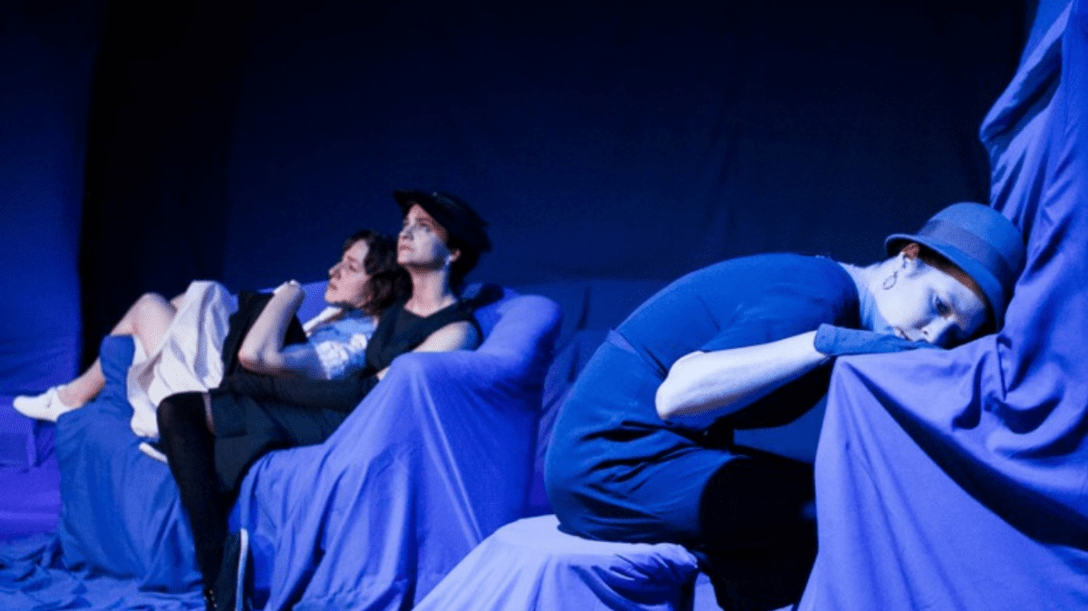
A man, naked except for a cup and a clown hat, rolls down off a wooden giraffe and stumbles toward us.
“Are you amused?” He shouts, showering us all with spit. “Does this look like a joke?” He points to his groin and begins to hump the air. “This is how the batter gets made, baby! Mix it up!”
This goes on for several minutes until two angels appear from the wings, or whatever amounts to the wings in a black box, and drag him away, probably to the next act where he will be resurrected as some kind of heroic symbol of Freudian psychology.
Several of my fellow audience members clap as he is dragged away. I would clap, but I don’t want to give the man the impression I like his performance. I like the fact that he is being dragged away.
It is 8:12 on a Friday night, and I am bored. So far in this show I have seen a woman blowing bubbles while the sound of artificial tech buzz cuts through a sea of fog and red light. I have seen cross dressing angels and a man who literally looks like he stepped out of an Edvard Munch painting. Hell, a naked man humped the air near my best friend’s head for over two minutes, and I still can’t seem to give a shit about this production.
But this, I guess, is the risk you run when you go to a show that advertises itself as “experimental”. Sometimes, it’s a revelation. Sometimes, you get sweaty man-junk in your face. Sometimes, it’s both.
I love experimental art work. I’ve worked created experimental theatre companies, made bizarre text-performance collages, and helped create an adaptation of Chekhov’s Three Sisters where we cut all characters except for the titular sisters. I don’t know if all of it was good, but it was at least interesting, which is sometimes the best you can hope for.
But a lot of experimental art also makes me want to dig a hole in the sand, shove my head down it, and scream until my voice gives out.
The problem, I’ve come to realize, is a confusion of genre and spirit. When you go to a show advertised as an experimental work, it no longer guarantees that it actually is. A lot of what is labeled as experimental looks “experimental”, which is to say it has all of the hallmarks of the theatre of the absurd, is influenced by Brecht, or finds inspiration from performance art. Some, like in the Wooster group or Dallas’ Dead White Zombies, will create multimedia experiences. Anything that doesn’t engage with fourth wall realism or the aesthetic of a Broadway musical.
But just because something looks experimental does not mean that it is actually a product of experimentation. This might seem like an argument in semantics, but I think it’s actually at the center of what I love and hate about experimental art. When audiences and critics identify a product by a genre, they are creating a taxonomy grouping similar, seemingly like productions together. Rarely, if ever, do they reference how or why shows actually get made. With some productions, this might not matter all that much. For example, a science fiction or fantasy author chooses to operate under a specific set of prearranged literary constraints. But with artistic experimentation, process is everything.
 On the Shoulders of Giants