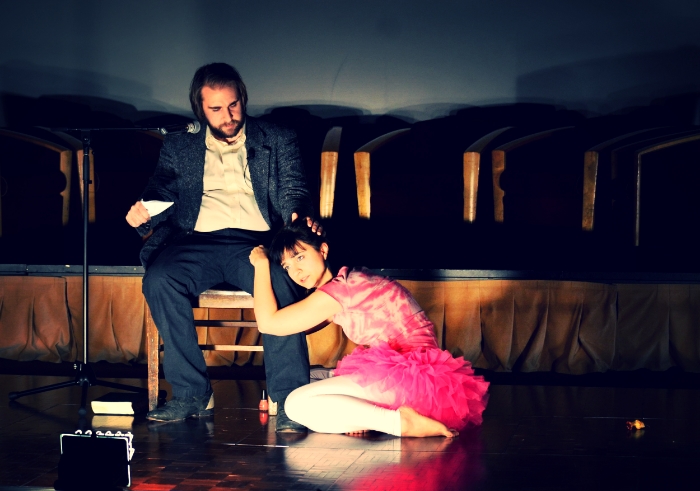
Humbert Humbert is not a nice man. This is probably the literary understatement of the year, but it bears repeating, especially since, while reading Vladamir Nabokov’s masterwork Lolita, it is possible to lose sight of it. Nabokov’s prose is so dense, his language so visceral, that it is easy to lose yourself in metaphor and poetry rather than remember that you are reading the supposed confessions of a pedophile, rapist, and murderer.
Nabokov tries to get you to admire pederast, because he loves beautifully. It is an exquisite justification of something that is not justifiable.
In presenting Young Matrix, Unknown Heart, a twenty-five-minute rendering of Lolita for DePaul university’s “Making the Novel Novel” series, Theatre Y and I were not trying to close this ethical black hole. But we did want to point out to people that it was there. The text, pasted together from passages of the novel and Kubrik’s film adaptation, attempted to mirror and amplify H.H.’s language, which is often that of a poetic surgeon. Nabokov writes: “My only grudge against nature was that I could not turn my Lolita inside out and apply voracious lips to her young matrix, her unknown heart, her nacreous liver, the sea-grapes of her lungs, her comely twin kidneys.”
Yet this is exactly what H.H. does. Humbert Humbert’s meticulous eyes uncover meticulous detail. In one passage, he analyzes the gait of a girl named Rose, where he sees, “A faint suggestion of turned in toes. A kind of wiggly looseness below the knee prolonged to the end of each footfall. The ghost of a drag. Very infantile, infinitely meretricious.” Our entire journey with H.H. absolutely drips with the honey of these details. As they crisscross the country, he and his Lolita “Voraciously consumed those long highways, in rapt silence we glided over their glossy black dance floors,” observing “a line of spaced trees silhouetted against the horizon, and hot still noons above a wilderness of clover, and Claude Lorrain clouds inscribed remotely into misty azure with only their cumulus part conspicuous against the neutral swoon of the background.”
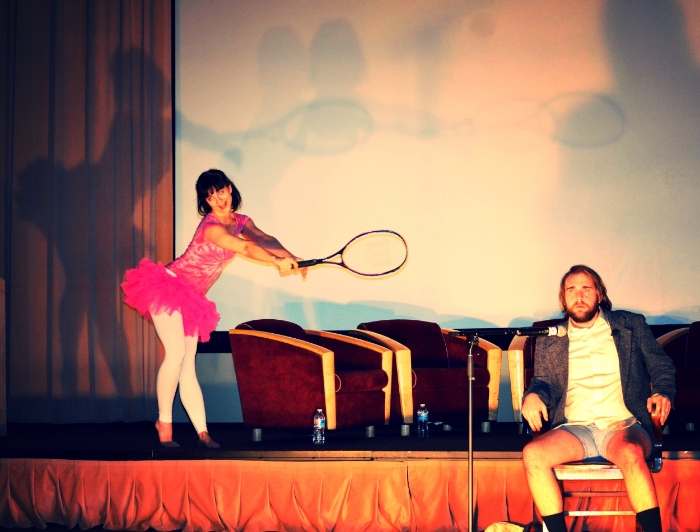
The beauty of some of these passages can’t be overstated. Even a prolonged passage that describes H.H. surreptitiously masturbating while Lo plays on his lap is gorgeously told, like a pile of shit etched in gold leaf. For Nabokov, this was the point of the book: to see how beautiful he could make a story about absolute depravity. “…Lolita has no moral in tow. For me a work of fiction exists only in so far as it affords me what I shall bluntly call aesthetic bliss, in that sense of being somehow, somewhere, connected with other states of being where art (curiosity, tenderness, kindness, ecstasy) is the norm.”
Yet it is in this beauty, this detail, that we lose sight of the larger whole. Delicious detail about a thigh obscures whose thigh H.H. is describing, effectively tearing it away from its context and holding it up for rapt examination, like an artist snipping out photographs for a collage.
Instead of trying to re-tell the story or re-interpret it, which would have been absolute madness for such a short production, I instead decided to out snip the snipper. I took Nabokov’s text, along with a few scenes from Kubrik’s adaptation to vary up the dialogue a bit, and cut it apart, image by image. Re-assembling it into something that was coherent was the hard part, but in the end, we were able to distill it down to a twenty-page document that exemplifies this obfuscating effect. With the text in hand, Evan (playing H.H.) and Melissa (Playing Lo) have created a performance that is at once utter blasphemy to Nabokov’s technical structure, but simultaneously retains the novel’s emotional heart and poetic imagination, all while exposing the cold, medical eye of it’s narrator. By using surrealist structure, we are able to hold H.H.’s most beautiful moments side by side with his most brutal, perhaps giving a truer sense of who he is than his ‘confession’ ever does.
 On the Shoulders of Giants